How ERP Systems Can Transform Your Financial Management


Enterprise Resource Planning (ERP) is a feature-packed business management software solution for organizations looking to bolster their financial operations. ERP systems are sophisticated software solutions integrating various processes essential to running a business, including finance, accounting, supply chain management, HR, and procurement, into a single software solution.
In this article we cover
- Using Enterprise Resource Planning for Financial Management
- Key ERP Finance Module Capabilities
- Top ERP Systems with Robust Financial Management Modules
- Financial Efficiency Features in ERP
- AI-Powered Financial Capabilities in Modern ERP
- Integration Challenges and Implementation Considerations
- Efficiency and Cost Reduction with ERP
- Compliance, Risk Management, and Security in ERP Finance Systems
- Enhanced Forecasting, Budgeting, and Financial Reporting
- Frequently Asked Questions
At its core, ERP finance capabilities provide a comprehensive, real-time view of an organization’s financial health, streamlining tasks such as accounting, budgeting, and reporting.
ERP software ensures financial information flows seamlessly throughout an organization by unifying financial data and processes across departments.
This centralized approach enhances visibility and supports informed decision-making.
Using Enterprise Resource Planning for Financial Management
ERP solutions improve financial management by providing a centralized platform that streamlines processes, cuts costs, and strengthens security. These systems integrate various business processes, optimizing operations and minimizing manual labor.
ERPs include comprehensive tools for monitoring financial activities, budgeting, managing expenses, and assessing risks. This integration enables businesses to extract valuable insights into their economic performance. Additionally, ERP systems include robust security features that protect sensitive financial information from unauthorized access, ensuring confidentiality and enabling businesses to focus on their primary goals with confidence.

Key ERP Finance Module Capabilities
An ERP finance module, a crucial component of an enterprise resource planning system, comprises features designed to handle various financial tasks.
These modules include
General Ledger (GL), which maintains all financial transactions; Accounts Payable (AP), which manages outgoing money, including vendor payments, and Accounts Receivable (AR), which handles incoming payments from customers. Asset Management tracks company assets and their depreciation, while Cash Management monitors and manages cash flow.
These modules work together seamlessly to provide a comprehensive financial suite.
Let’s take a closer look at two areas of critical functionality:
General Ledger and Financial Reporting
The general ledger serves as a central repository for all financial transactions. Its primary functions include
- Tracking: Recording every financial transaction reliably
- Consolidation: Combining data from multiple departments or subsidiaries
- Reporting: Providing crucial data for financial reports, which are essential for both internal and external stakeholders
Organizations rely on the general ledger to generate accurate financial statements and ensure compliance with reporting requirements.
Accounting and Financial Management
The accounting capabilities within an ERP financial module include
- Maintaining all transactional records
- Ensuring compliance with accounting standards
- Providing insights for financial management strategies
Effective financial management involves overseeing resources, mitigating risks, and enhancing profitability by leveraging the data captured in the ERP system.
Top ERP Systems with Robust Financial Management Modules
Over the years, we’ve worked with various ERP systems and have encountered several solutions that stand out for their robust financial management capabilities.
Our ERP comparison tools let you dive deeper into each system’s features and capabilities, making it easier to find the perfect match for your organization’s unique needs.
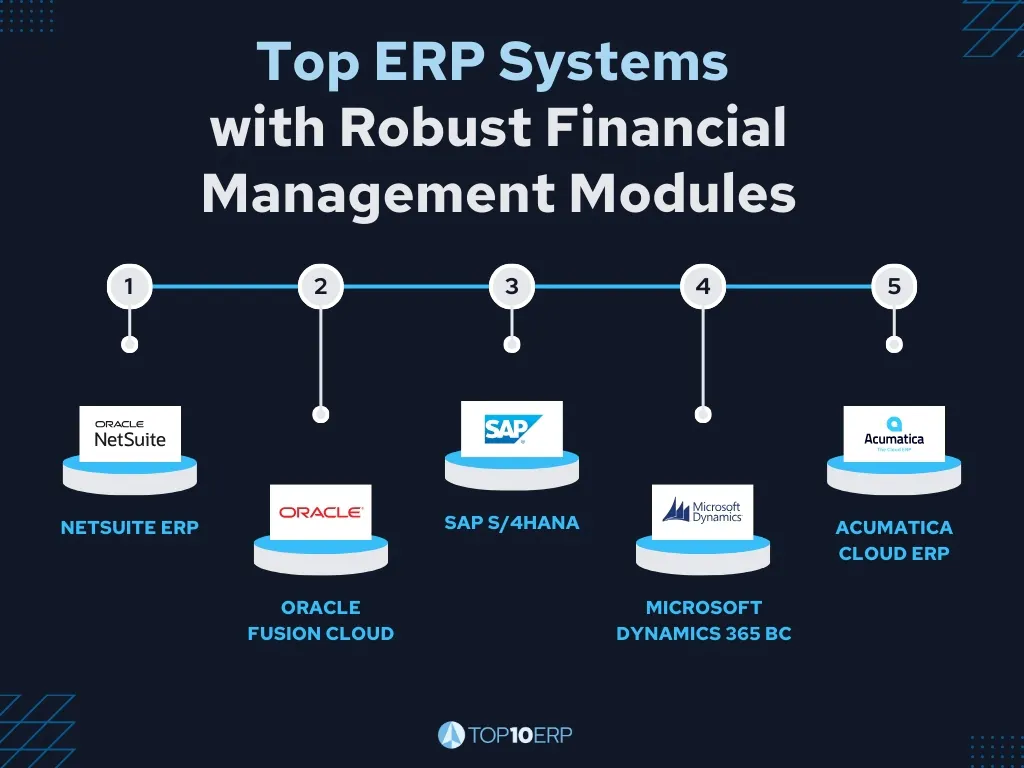
NetSuite ERP
NetSuite ERP is a leading cloud-based solution for managing back-office operations and financial processes. It serves over 43,000 global customers and offers robust financial management, inventory, supply chain, and real-time analytics. This platform prioritizes innovation, growth, and swift decision-making through unified business insights.

Microsoft Dynamics 365 Business Central
Dynamics 365 Business Central is an ERP for small to mid-sized businesses, offering integrated solutions for finance, manufacturing, and sales. It seamlessly integrates with Microsoft tools, offers real-time cloud access, and scales with business growth.

Acumatica Cloud ERP
Acumatica Cloud ERP is a versatile system tailored for growing businesses. It integrates accounting, sales, and customer management with industry-specific add-ons and advanced technologies like AI and IoT. With a user-friendly interface and global adaptability, Acumatica stands as a premier, affordable ERP solution.

SAP S/4HANA
SAP S/4HANA Cloud is an ERP system for manufacturers with AI, machine learning, and analytics. It provides real-time insights into manufacturing processes, facilitates quick adjustments to demand changes, and enables better decision-making. The system supports seamless integration with other SAP solutions and is extendible for enterprise-wide processes.

Epicor Kinetic
Epicor Kinetic, formerly Epicor ERP, is tailored for various manufacturing needs. It offers both cloud and on-premises options and excels in real-time monitoring, quality management, and global financial integration. Its user-friendly design ensures intuitive navigation and robust global support, fostering business growth and efficiency.

See a side-by-side comparison of these 5 systems or request free demos and price quotes.
Financial Efficiency Features in ERP
ERP systems offer a range of features designed to enhance financial efficiency and improve multiple aspects of financial management. Many leverage AI technologies to automate processes, improve decision-making, and optimize workflows.
Automation of Financial Transactions
- Improves the efficiency of financial management by automating repetitive tasks.
- Reduces the likelihood of manual errors.
- Ensures accuracy within the accounting system.
Optimizing Procurement and Purchasing Workflows
- Centralized vendor management enables efficient transaction tracking and performance evaluation.
- Automated workflows ensure compliance with company policies.
- Purchase order automation minimizes delays in the purchasing process.
Expense Management Benefits
- Tracks costs and manages budgets.
- Enforces spending limits with automated alerts.
- Optimizes cash flow
Cross-Departmental Collaboration
- Breaks down silos to create a single source of truth.
- Eliminates miscommunications and delays.
- Promotes a continuous process of financial management.
AI-Powered Financial Capabilities in Modern ERP
Artificial intelligence has fundamentally changed how ERP systems handle financial management. AI has raised the bar beyond simple automation to deliver intelligent insights, predictive capabilities, and autonomous decision support.
The AI integrations we’re seeing now represent a significant leap from earlier generations of financial software, with major vendors partnering with AI leaders like NVIDIA and Microsoft to embed sophisticated machine learning and generative AI directly into core finance modules.
Intelligent Analysis and Predictive Forecasting
AI-powered ERP systems excel at processing vast amounts of financial data to identify patterns, trends, and anomalies that would be difficult for human analysts to detect manually. Modern machine learning algorithms continuously analyze transaction data, comparing current activity against historical patterns and industry benchmarks to flag unusual spending patterns, revenue anomalies, or potential compliance issues before they become problems.
Predictive modeling analyzes historical data alongside external factors such as market trends and economic indicators to generate increasingly accurate forecasts of cash flow, revenue, expenses, and resource needs.
Organizations can run complex what-if scenarios in seconds to model how different strategic decisions might affect financial outcomes, with predictions that improve over time as the system learns from actual results.
Autonomous Agents and Intelligent Automation
The latest ERP systems introduce autonomous AI agents capable of handling routine financial tasks with minimal human oversight. These agents process invoices, match payments, reconcile accounts, and respond to common financial queries from employees across the organization.
Month-end and quarter-end close processes benefit significantly from AI assistance. Autonomous agents execute routine closing tasks, perform preliminary reconciliations, identify discrepancies requiring attention, and prepare draft financial statements.
Enhanced Fraud Detection and Accessible Insights
AI excels at identifying potential fraud and financial risks by recognizing subtle patterns that indicate suspicious activity. Unlike rules-based systems that only catch known fraud patterns, AI can identify novel schemes by detecting statistical anomalies and unusual combinations of legitimate activities.
Natural language processing has made ERP systems more accessible to non-finance users. With a conversational interface, executives and managers can now ask questions in plain language and receive immediate, accurate responses with supporting visualizations.
Integration Challenges and Implementation Considerations
While ERP financial systems offer substantial benefits, successful implementation requires careful planning and realistic expectations about the challenges involved. Organizations should approach ERP deployment with a clear understanding of both the opportunities and obstacles they’ll encounter.
Data migration represents one of the most significant hurdles in ERP implementation. Financial data accumulated over years in legacy systems must be cleaned, validated, and transformed to fit the new system’s structure. Organizations should allocate substantial time for data mapping workshops and validation testing before go-live.
Change management deserves equal attention to technical implementation. Finance teams accustomed to familiar interfaces and established workflows may resist new processes, even when those processes are objectively better. Successful implementations invest heavily in user training that goes beyond basic system navigation, helping teams understand how the ERP’s integrated approach changes their daily responsibilities and decision-making processes.
The value of ERP comes partly from adopting industry-standard processes. Over-customization not only increases implementation costs but can also complicate future upgrades and limit the system’s ability to adapt to changing business needs. The key is distinguishing between true business requirements and preferences that have genuine business value.
Efficiency and Cost Reduction with ERP
ERP integrates various financial operations, including tax, asset, and revenue management , to enhance efficiency and promote cost savings.
Many of these features lead to cost savings, including:
- Automation: Reduces manual entry and processing time, minimizing human error.
- Data Consolidation: Facilitates accurate financial reporting and transparent operations.
- Expense Management: Provides tools for tracking costs, managing budgets, and enforcing spending limits with automated alerts and business rules.
- Improved Accuracy: Decreases accounting errors through consistent data management.
- Enhanced Reporting: Supports timely and precise financial analysis, ensuring all departments have access to the same updated data.
Incorporating inventory management into the ERP further enhances efficiency and cost savings by streamlining production planning, purchasing, and customer relationship management. Integrating supply chain management with ERP finance modules stands out as a critical differentiator, optimizing cash flows and saving time by ensuring seamless information flow from the supply chain team.
Overall, ERP finance modules significantly cut costs and boost businesses’ financial health by enhancing expenditure control.
Compliance, Risk Management, and Security in ERP Finance Systems
ERP systems are crucial for ensuring regulatory compliance, managing risks, and securing sensitive data within organizations.
Ensuring Financial Compliance Through ERP
ERP systems are instrumental in helping organizations adhere to various regulatory standards and support audit processes. They automate the generation of necessary reports for bodies like the SEC, GAAP, or IFRS, and include critical features such as:
- Audit Trails: Monitor and record all data changes to ensure transparency and integrity.
- Control Mechanisms: Restrict access and define user roles to enhance data security.
Integrated Risk Management Strategies
ERP software incorporates risk management as a core function, allowing for the effective monitoring and mitigation of financial risks through:
- Real-Time Monitoring: Alerts are triggered by the system when it detects financial anomalies or irregularities.
- Predictive Analysis: Utilizes historical data to anticipate potential risks, enabling proactive management.
Security and Data Protection
The security of financial information within ERP is paramount to protect against data breaches and ensure data confidentiality and integrity, especially with cloud ERP.
Key security measures include
- Encryption: Secures data at rest and in transit, preventing unauthorized access.
- Access Controls: User authentication and role-based access control restrict data access.
- Security Protocols:
- Firewalls: Serve as a barrier against unauthorized external access.
- Intrusion Detection Systems (IDS): Monitor for and alert on suspicious network activities.
- Regular Security Audits: Ensure systems are secure and up to date, and check for vulnerabilities.
These ERP features comply with stringent regulations like GDPR and SOX and strengthen an organization’s ability to manage financial data accurately and securely. ERP enhances overall financial governance and safeguards organizational assets by integrating compliance, risk management, and security into the financial workflows.
Enhanced Forecasting, Budgeting, and Financial Reporting
ERP software uses advanced algorithms to process historical data, significantly improving forecast and budgeting accuracy. These systems convert raw data into actionable insights on revenue, costs, and market trends.
Forecasting Techniques in ERP include
- Driver-based Forecasting: Links business drivers directly to financial results.
- Rolling Forecasts: Continuously updated to mirror current financial conditions.
- What-if Analysis: Evaluate potential financial outcomes of different scenarios.
Real-Time Financial Reporting
ERP software offers real-time reporting, which is essential for quick decision-making. This functionality ensures financial leaders have real-time insights into balance sheets, income statements, and cash flow. It also integrates data from various departments, ensuring compliance with standards and facilitating comprehensive governance.
Profit Tracking and Revenue Optimization
ERP enhances financial visibility, effectively tracking profit margins across different business areas. They analyze real-time data, helping identify underperforming products and profitable customer segments. Additionally, ERPs improve revenue and cash flow management by forecasting future revenues and aligning accounts receivable and payable to maintain liquidity.
These capabilities make ERP software an indispensable tool for optimizing financial performance and ensuring healthy cash management practices.
Frequently Asked Questions
The FAQs cover how ERP systems enhance financial operations, discussing their features, their impact on reporting, the roles they create, and their support for strategic financial decisions.
How does an ERP system streamline financial processes within an organization?
An ERP system integrates financials, automates core accounting tasks, and provides a centralized platform that simplifies financial management. It reduces manual effort, enhances accuracy, and provides real-time financial insights, assisting organizations in creating efficient business processes.
What are the core features of an ERP finance module?
The core features of ERP financial modules typically include general ledger, accounts payable, accounts receivable, fixed assets, and cash management capabilities. These modules assist in comprehensive data management and allow for streamlined budgeting, forecasting, and financial reporting.
What impact does ERP software integration have on financial reporting and compliance?
ERP integration standardizes financial reporting and ensures adherence to compliance by providing accurate and timely financial information. It simplifies the consolidation of financial statements from various departments and supports compliance with local and international accounting standards.
What are the typical job roles for managing ERP in the finance sector?
Typical job roles associated with ERP in the finance sector include ERP Financial Analyst, ERP System Administrator, Financial Controller, and Chief Financial Officer (CFO). Their responsibilities range from monitoring system performance to strategic planning and financial reporting.
How do ERP solutions support strategic decision-making in finance?
ERP software provides finance professionals with comprehensive analytics and predictive insights. These support strategic decision-making. Access to real-time data, performance metrics, and financial projections enables businesses to make informed, strategic financial decisions.