One Database, Zero Middleware: A Close Look at DELMIAWorks ERP


At Top10ERP, we understand the critical role that an effective Enterprise Resource Planning (ERP) system plays in manufacturing operations. Many manufacturers struggle with ERP systems that manage finances well but can't capture the complexities of the shop floor. Here, we review DELMIAWorks, a unified ERP/MES solution built for discrete manufacturers, featuring single-database architecture and real-time production monitoring.
In this article we cover
- Overview of DELMIAWorks
- The Single Database Advantage: Unified Architecture
- RealTime™ Process Monitoring: DELMIAWorks’ Digital Heartbeat
- DELMIAWorks Cloud Platform and Deployment Options
- Key Components of DELMIAWorks ERP
- Integration with the Dassault Systèmes Ecosystem
- Why DELMIAWorks Stands Out for Manufacturers
- Support for Global Manufacturing with DELMIAWorks
- Industries Benefiting from DELMIAWorks
- DELMIAWorks: Understanding the Costs and Value
- How Top10ERP Can Help with Your ERP Selection
- Frequently Asked Questions About DELMIAWorks
Overview of DELMIAWorks
DELMIAWorks is a unified ERP system designed specifically for mid-market discrete manufacturers. Unlike traditional ERP systems that treat the production floor as a separate entity requiring bolt-on solutions, DELMIAWorks was built from its inception with a “shop floor first” philosophy.
Originally developed as IQMS in 1989, the platform was acquired by Dassault Systèmes in 2019, bringing it into the broader 3DEXPERIENCE ecosystem. The defining characteristic of DELMIAWorks is its single Oracle database architecture: Production data, financial transactions, quality records, and inventory movements all live in the same database, eliminating the data synchronization issues that plague manufacturers using separate ERP and MES systems.
DELMIAWorks
DELMIAWorks (Previously IQMS) Manufacturing ERP stands out as a holistic ERP and MES solution tailored specifically for the manufacturing industry, addressing the unique needs and challenges faced by manufacturers globally. Notably, its single-source development ensures that the system is less complex and more cost-effective than multi-solution alternatives.

Key Highlights:
- Single Database Architecture: Unified ERP/MES eliminates middleware and ensures real-time data accuracy across all business functions.
- Shop Floor First Design: Built to handle the physical realities of manufacturing with real-time process monitoring.
- Flexible Deployment Options: Choose from on-premise, managed cloud, or SaaS deployment without sacrificing functionality.
- Industry-Specific Functionality: Deep capabilities for plastics, medical devices, automotive, and other regulated manufacturing environments.
- SolidWorks Integration: Native connection to the Dassault Systèmes ecosystem for seamless engineering-to-manufacturing workflows.
- RealTime™ Monitoring: Hardware-level connectivity to production equipment for automated data collection and live OEE tracking
The Single Database Advantage: Unified Architecture
The single database architecture is where DELMIAWorks fundamentally differs from most other ERP systems. In a typical manufacturing technology stack, the ERP manages financials and planning while a separate MES handles shop floor execution. These systems communicate through APIs, middleware, or batch updates that rarely align in real time.
DELMIAWorks operates on a single, monolithic Oracle database. Every transaction, whether it happens in accounts payable or on the injection molding press, writes to the same database instantly. This architectural decision has profound implications for how manufacturers operate.
When a machine completes a production cycle, several things happen simultaneously: raw material inventory decreases, work-in-process value increases, machine utilization statistics update, and cost of goods sold calculations adjust, all in one transaction. There’s no synchronization lag, no reconciliation process, and no wondering which system has the “right” number.
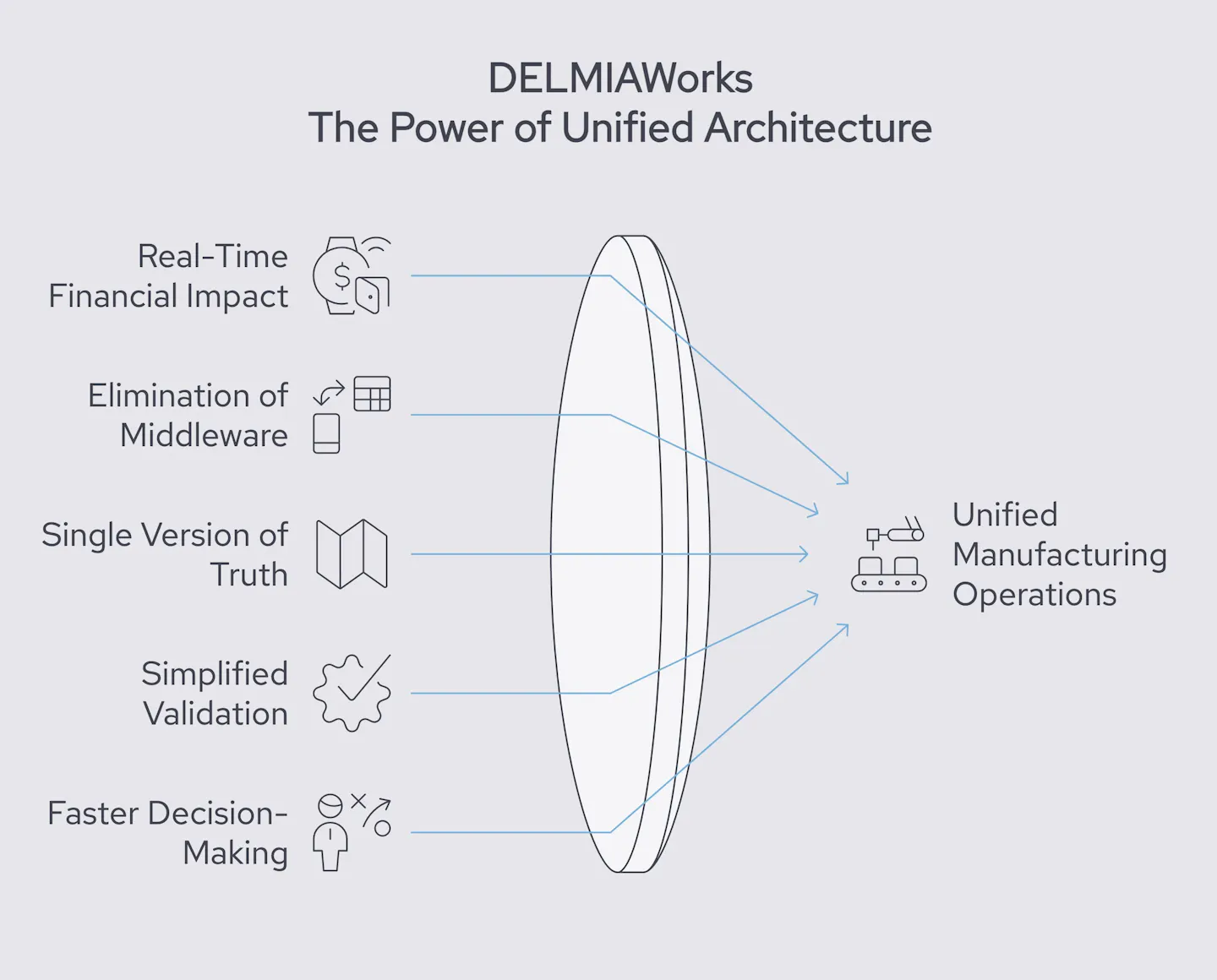
Benefits of the Unified Architecture
Real-Time Financial Impact: Production events update financial records in real time. When the shop floor consumes materials or completes parts, the general ledger reflects it instantly.
Elimination of Middleware: Without separate systems requiring integration, there are no API connections to maintain, no middleware to troubleshoot, and significantly fewer points of failure. This reduces IT burden and total cost of ownership (TCO).
Single Version of Truth: All modules (Quality Management, Warehouse Management, EDI, and CRM) share the same master data tables. When engineering updates a Bill of Materials, purchasing and scheduling see the change immediately.
Simplified Validation: For regulated industries like medical devices, validating a single unified system is considerably less complex than validating multiple integrated systems and testing their interfaces.
Faster Decision-Making: Managers can trust that the data they’re viewing is current. There’s no need to call the shop floor to verify what the system shows or wait for overnight updates to see yesterday’s production.
This unified architecture makes DELMIAWorks particularly effective for manufacturers who need tight control over production costs and traceability.
RealTime™ Process Monitoring: DELMIAWorks’ Digital Heartbeat
Most ERP systems claim “real-time” visibility, but typically mean real-time access to manually entered data. DELMIAWorks establishes direct, physical connections to manufacturing equipment, creating a cyber-physical loop that bypasses human data entry entirely.
Programmable Logic Controllers (PLCs) on newer machines connect via IP networking, while Machine Interface Units (MIUs) handle older equipment by wiring into machine relays. The most visible element is the RealTime™ LightSticks — physical devices that change color based on real-time performance, providing immediate visual feedback across the shop floor.
This connectivity transforms the factory floor into a transparent, data-driven operation with immediate visibility into production status, costs, and performance.
DELMIAWorks Cloud Platform and Deployment Options
Manufacturing facilities exist in diverse circumstances, from rural plants with unreliable internet to defense contractors with strict data sovereignty requirements. DELMIAWorks addresses these diversities with their “Choice is the New Cloud,” deployment philosophy that prioritizes flexibility over forcing customers into a single infrastructure model.
DELMIAWorks provides three distinct deployment options: on-premise, managed cloud, and SaaS. The critical advantage here is that all three options run the exact same codebase with identical functionality. This isn’t a “lite” cloud version versus a “full” on-premise system, it’s the same software deployed differently.
This approach allows manufacturers to choose based on their specific operational needs, regulatory requirements, and IT capabilities without sacrificing features. A company can start on-premise and migrate to the cloud later, or vice versa, without reimplementing the system or retraining users.

DELMIAWorks ERP Deployment Options
On-Premise Deployment
- Infrastructure: Customer’s own servers or private cloud
- License Model: Perpetual license (CapEx investment)
- Maintenance: Customer IT manages hardware, operating system, backups, and security
- Upgrade Control: Complete control over upgrade timing — critical for validated environments
Best suited for defense contractors with ITAR requirements, manufacturers with strict data security needs, or facilities in areas with unreliable internet connectivity
Managed Cloud
- Infrastructure: DELMIAWorks’ secure data center
- License Model: Perpetual license (CapEx investment)
- Maintenance: DELMIAWorks manages hardware and infrastructure; the customer manages applications
- Upgrade Control: High control over upgrade timing while eliminating hardware management burden
Best suited for companies wanting asset ownership without the IT maintenance overhead
SaaS (Software as a Service)
- Infrastructure: DELMIAWorks’ public cloud infrastructure
- License Model: Subscription (OpEx investment)
- Maintenance: DELMIAWorks manages everything — hardware, infrastructure, and applications
- Upgrade Control: Automatic updates with less individual control over timing
Best suited for startups, agile manufacturers, and companies preferring operational expenses over capital investment
This deployment flexibility acknowledges that manufacturing isn’t a one-size-fits-all industry. A medical device manufacturer validating their system for FDA compliance has different needs than a contract molder scaling rapidly. DELMIAWorks accommodates vast manufacturing requirements without compromise.
Key Components of DELMIAWorks ERP
DELMIAWorks offers a comprehensive suite of modules designed to manage the complete manufacturing operation. They are purpose-built tools that understand the physical realities of production environments.

Below are the core components that make this system a great choice for discrete manufacturers:
Advanced Planning and Scheduling (APS)
The scheduling engine in DELMIAWorks handles finite capacity scheduling, understanding that machines, tools, and people have real limits. This enables accurate planning that accounts for actual shop floor constraints.
Auto Capacity Balancing: Automatically level-load the shop floor by optimizing schedules to minimize changeovers and maximize throughput.
Auxiliary Equipment Constraints: Schedule based on tooling and auxiliary equipment availability, preventing jobs from being scheduled when required molds or fixtures are already in use.
Capable to Promise (CTP): Provide customers with accurate delivery dates by simulating orders against live schedules, considering machine load, material availability, and lead times.
Inventory and Warehouse Management (WMS)
DELMIAWorks manages inventory with the granularity required by regulated manufacturing environments. The system maintains complete traceability through every stage of production.
Dimensional Inventory Logic: Track inventory by lot, serial number, location, shelf life, and status across unlimited warehouse locations.
Shelf Life Management: Monitor expiration dates for perishable materials and enforce First-Expiry-First-Out (FEFO) logic to minimize waste.
Native WMS: Support barcode scanning, directed picking, wave picking, and license plating for efficient material movement and real-time transactions.
Production Management
Managing production effectively requires visibility into current operations and control over what happens next. DELMIAWorks provides real-time oversight and quality integration throughout the manufacturing process.
Shop Floor Control: Monitor production status in real time to identify bottlenecks and respond to issues as they occur.
Quality Assurance Integration: Enforce quality checkpoints directly in production workflows where jobs cannot proceed until inspection is complete.
Work Order Management: Connect planning to execution with detailed tracking that ensures the shop floor has required materials, tools, and information.
Financial Management
The financial modules are built for manufacturing, providing the cost control and variance analysis that production-focused businesses need to maintain profitability.
Real-Time Costing and Variance Analysis: Track standard costs versus actual costs based on live production data to identify exactly why jobs are profitable or not.
Multi-Currency and Multi-Company Support: Handle transactions in multiple currencies and consolidate financial data across corporate entities.
Standard vs. Actual Costing: Set expected costs based on planned performance, then compare against actual costs using real cycle times, material consumption, and labor hours.
Customer Relationship Management (CRM)
Building strong customer relationships requires visibility into every interaction and the ability to respond quickly. DELMIAWorks CRM connects customer management directly to manufacturing operations.
Sales Management: Streamline lead tracking, opportunity management, and sales processes to move prospects efficiently through the pipeline.
Customer Support: Manage inquiries and service requests with full visibility into order history, quality records, and production status.
Order Management: Connect customer requirements directly to production scheduling and material planning for seamless order fulfillment.
Maintenance, Repair, and Operations (MRO)
The MRO module connects maintenance planning to equipment usage, enabling predictive strategies that extend asset life and prevent failures.
Cycle-Based Maintenance: Schedule maintenance based on actual equipment usage rather than arbitrary calendar dates, tracking metrics like machine cycles or production hours.
Preventative Maintenance Scheduling: Automatically generate maintenance work orders before equipment reaches service intervals and block assets from being scheduled beyond their limits.
Asset Management: Track maintenance history, spare parts inventory, and equipment performance to optimize maintenance strategies and reduce downtime.
Integration with the Dassault Systèmes Ecosystem
One of the most compelling aspects of DELMIAWorks under Dassault Systèmes ownership is its integration with SolidWorks. For the 250,000+ small to mid-sized manufacturers who use SolidWorks for design, this integration eliminates the manual data transfer and transcription errors that typically occur when moving from CAD to production.
The SolidWorks Add-In allows engineers to push Bill of Materials data directly from SolidWorks into DELMIAWorks, automatically creating manufacturing BOMs from engineering specifications. Visual documents such as drawings, PDFs, and eDrawings, link directly to work orders, allowing shop floor operators to view the latest approved drawings without leaving the ERP interface.
The 3DEXPERIENCE Bridge connects the on-premise DELMIAWorks database with the cloud-based 3DEXPERIENCE platform, synchronizing product, process, and resource data across the product lifecycle. This provides a migration path where DELMIAWorks serves as the execution engine while broader PLM and simulation tasks move to the cloud.
The integration flows primarily from engineering to manufacturing. SolidWorks PDM remains the master for design files, while DELMIAWorks becomes the master for transactional manufacturing data.
Why DELMIAWorks Stands Out for Manufacturers
Our analysis of manufacturing ERP solutions shows that DELMIAWorks delivers particular value for manufacturers who view production control as their competitive advantage. The system’s unified architecture and real-time monitoring capabilities address challenges that generic ERPs either ignore or handle through expensive customization.

Elimination of Data Latency
The single-database architecture eliminates the gap between shop floor events and business system updates, providing manufacturers with immediate visibility into production costs and performance.
- Instant financial updates as production events occur
- Synchronized data across all departments without batch processing
- Accurate cost visibility based on actual performance, not estimates
Industry-Specific Capabilities Without Customization
DELMIAWorks handles manufacturing complexities that other systems treat as edge cases requiring expensive customization. The software natively understands the physical realities of discrete manufacturing.
- Cavitation management for injection molding operations
- Family tool handling for molds producing multiple part numbers simultaneously
- Regrind consumption tracking with blend ratio management
Regulatory Compliance and Quality Control
For manufacturers in regulated industries, compliance features are embedded throughout the system rather than bolted on as afterthoughts, reducing administrative overhead and validation complexity.
- Automated Device History Record (DHR) compilation for medical devices
- FDA 21 CFR Part 11 electronic signature support
- Complete audit trails for all critical transactions
Deep Lot and Serial Traceability
The dimensional inventory tracking provides the traceability that quality-focused manufacturers require. When supplier issues or quality concerns arise, this capability protects both product integrity and customer relationships.
- Track every lot by location, status, shelf life, and material certificates
- Identify all finished goods impacted by a material recall within minutes
- Manage quality quarantine workflows with full audit visibility
Deployment Flexibility for Diverse Needs
The ability to choose between on-premise, managed cloud, and SaaS deployment addresses real operational constraints without compromising functionality. The same codebase runs in all three environments.
- Defense contractors with ITAR data sovereignty requirements
- Manufacturers in areas with unreliable internet connectivity
- Migration between deployment options without reimplementation
Real-Time Production Control
The RealTime™ monitoring creates a level of shop floor visibility that fundamentally changes how manufacturers operate. This is continuous feedback that drives automated responses across the enterprise.
- Automated production counting eliminates manual end-of-shift tallies
- Live OEE calculations with dynamic schedule adjustments
- Process parameter monitoring to prevent scrap before it happens
Support for Global Manufacturing with DELMIAWorks
Manufacturers operating internationally can face many challenges, such as managing multiple currencies, adhering to diverse regulations, and coordinating complex supply chains. DELMIAWorks addresses these requirements through native multi-currency support, automatic exchange rate updates, and country-specific tax calculations that maintain compliance across different jurisdictions.
The platform provides global inventory tracking with real-time visibility across international warehouses. It balances centralized control through a unified database with local adaptation, allowing regional units to customize processes for specific market demands while maintaining alignment with overall company strategies.
Industries Benefiting from DELMIAWorks
DELMIAWorks serves discrete manufacturers across multiple industries, with particularly strong capabilities in sectors that demand rigorous quality control, complex production processes, and detailed traceability, such as the plastics manufacturing industry.
Its shop-floor-first architecture and industry-specific functionality make it effective for manufacturers who need more than generic ERP capabilities. Below are the industries that benefit most from this system:
Plastics and Injection Molding: Native support for cavitation, family tools, regrind consumption, and real-time process monitoring for injection, blow, and rotational molding operations.
Automotive Parts and Tier Suppliers: APQP workflows, EDI integration, AIAG labeling, and automotive release accounting for OEM compliance and just-in-time delivery requirements.
Medical Devices and Life Sciences: Automated Device History Records, FDA 21 CFR Part 11 compliance, ISO 13485 support, and comprehensive audit trails for regulated manufacturing.
Aerospace and Defense: Complex project management, stringent quality standards, material traceability, and ITAR-compliant on-premise deployment options.
Electronics and High-Tech Manufacturing: Component tracking, rapid product lifecycle management, and quality control for assembly operations.
Industrial Machinery and Equipment: Custom equipment production management, engineering change control, and after-sales service integration.
Metal Fabrication: Material usage optimization, production workflow management, and lot tracking for metals processing and fabrication.
Food and Beverage: Shelf life management, FEFO logic, strict traceability requirements, and compliance support for regulated food manufacturing environments.
DELMIAWorks: Understanding the Costs and Value
The investment in DELMIAWorks varies based on business size, complexity, and deployment model. Before committing to an ERP solution, it’s essential to understand the full scope of the investment and how the costs break down.
Pricing Overview
The pricing structure of DELMIAWorks is designed for mid-market manufacturers, with total software costs typically ranging from $25,000 to over $300,000 depending on the scale and complexity of the implementation. User costs average approximately $250 per user per month for subscription models, though perpetual licensing options are also available.
Implementation services typically start at $20,000 for basic setups but can exceed $100,000 for complex multi-plant configurations requiring extensive data migration, customization, and integration work.
Deployment and Cost Models
DELMIAWorks offers flexibility in how you structure the investment. On-premise and managed cloud deployments typically use perpetual licenses (CapEx investment), while SaaS deployment operates on a subscription model (OpEx investment). This flexibility allows companies to choose the financial structure that best aligns with their budgeting and accounting preferences.
Licensing Models: Named vs. Concurrent
One significant cost advantage for manufacturers is DELMIAWorks’ support for concurrent (floating) licensing in addition to standard named user licensing. Named user licenses are tied to specific individuals, ideal for power users like the CFO or quality manager who are logged in continuously. Concurrent licenses are based on the maximum number of simultaneous users.
For shift-based operations, this creates substantial savings. A factory running three shifts with 20 operators per shift (60 total employees) might only need 25 concurrent licenses (20 for the active shift plus 5 for overlap and management) rather than 60 named licenses. This licensing flexibility can significantly improve ROI for manufacturers with shift-based operations.
Cost Components
The total cost of DELMIAWorks includes several key elements:
Implementation Services: Covers consulting, system configuration, data migration, and customization to meet specific business needs.
Training and Support: Includes access to DELMIAWorks University, role-based certifications, and ongoing technical support tiers.
Software Licensing: Choose between perpetual licenses or subscription models based on financial preferences.
Infrastructure: Varies by deployment choice: on-premises requires hardware investment, while cloud and SaaS eliminate infrastructure costs.
Hardware Connectivity: RealTime™ monitoring requires PLCs, MIUs, or LightSticks depending on equipment age and connectivity needs.
Ongoing Maintenance: Annual maintenance fees for updates, support access, and system scalability.
Maximizing Your Investment
To optimize your DELMIAWorks investment, carefully assess essential needs to avoid unnecessary module expenses. Consider long-term costs and benefits beyond the initial implementation, including the operational gains from reduced scrap, higher equipment utilization, and decreased administrative overhead.
The unified ERP/MES architecture eliminates the cost of maintaining separate systems and their integration points, reducing the total cost of ownership over time. The RealTime™ monitoring capabilities can quickly demonstrate ROI through improved machine utilization and reduced manual data entry labor.
How Top10ERP Can Help with Your ERP Selection
Choosing an ERP system requires careful consideration. We offer comprehensive tools and services to simplify your decision-making process:
ERP Comparison: Use our Best-Fit ERP Comparison tools to compare DELMIAWorks with other leading ERP systems. Our detailed analysis helps you understand how different solutions address your specific manufacturing requirements.
Demo Access: Request product demonstrations to see DELMIAWorks and other ERP systems in action. These hands-on experiences provide valuable insights into user interfaces, shop floor connectivity, and real-time monitoring capabilities.
Price Quotes: Obtain customized price estimates based on your business requirements. Our service helps you understand the potential costs of various ERP solutions, including DELMIAWorks, across different deployment models.
Case Studies and White Papers Libraries: Access our case studies and white paper libraries to learn more about ERPs for your industry.
Selection Guidance: Our experts provide personalized advice to help you make an informed decision. We consider your industry, company size, regulatory requirements, and specific operational needs to recommend the best ERP solution.
These resources provide you with access to comprehensive information and expert support throughout your ERP selection process. We aim to help you find the right ERP system that aligns with your organization’s objectives and budget.
DELMIAWorks
DELMIAWorks (Previously IQMS) Manufacturing ERP stands out as a holistic ERP and MES solution tailored specifically for the manufacturing industry, addressing the unique needs and challenges faced by manufacturers globally. Notably, its single-source development ensures that the system is less complex and more cost-effective than multi-solution alternatives.
Frequently Asked Questions About DELMIAWorks
Is DELMIAWorks suitable for small and medium-sized businesses?
DELMIAWorks is designed for small to mid-market discrete manufacturers with 10 to several hundred employees. While the flexible deployment options and concurrent licensing make it accessible, it’s most suitable for companies with significant production complexity or regulatory requirements.
What makes DELMIAWorks different from other manufacturing ERP systems?
The primary differentiator is the single-database architecture that unifies ERP and MES functionality, eliminating data latency between the shop floor and back office. RealTime™ Process Monitoring connects directly to production equipment with out-of-the-box functionality for complex manufacturing scenarios.
What industries benefit most from DELMIAWorks?
DELMIAWorks excels in plastics and injection molding, automotive parts, medical devices, aerospace and defense, and other discrete manufacturing with complex processes. The system’s traceability, compliance features, and industry-specific functionality make it valuable for regulated manufacturing environments.
How long does it take to implement DELMIAWorks?
A typical single-plant implementation takes 4 – 8 months, while complex multi-site rollouts can take 9 – 12 months or longer. Fast-track implementations of 3 – 4 months are possible for smaller, less complex operations.
What kind of training and support is available for DELMIAWorks users?
DELMIAWorks University offers over 180 eLearning modules and 13 role-based certifications, plus instructor-led classes. Support ranges from Standard Advantage (business hours) to Gold (24÷7 with a dedicated Technical Account Manager).
Does DELMIAWorks integrate with SolidWorks and other design tools?
Yes, the SolidWorks Add-In pushes BOM data directly from SolidWorks into DELMIAWorks and links drawings to work orders. The 3DEXPERIENCE Bridge connects DELMIAWorks with Dassault’s cloud-based PLM platform for a complete digital thread.