Why These Are the Top 10 Food Manufacturing ERP Systems for 2026


At Top10ERP, we bring over 15 years of expertise in evaluating Enterprise Resource Planning (ERP) systems across a wide range of industries, with a particular focus on the manufacturing sectors. Our deep understanding of industry-specific challenges allows us to deliver thorough, unbiased evaluations that empower manufacturers to make informed decisions. Each year, we revisit and refine our recommendations to ensure they align with the evolving needs of key manufacturing industries.
In this article we cover
- Why Food Manufacturing Demands Specialized ERP Software
- How We Evaluate Food Manufacturing ERP Systems
- Top 10 Food Manufacturing ERP Systems Reviewed
- 1. BatchMaster Manufacturing ERP
- 2. Deacom ERP
- 3. INFOR Cloudsuite Process (Infor M3)
- 4. inecta Food ERP
- 5. Sage X3 ERP
- 6. QAD Adaptive
- 7. JustFood ERP
- 8. DELMIAWorks (IQMS)
- 9. Enterprise 21
- 10. Wherefour ERP
- How to Choose the Right Food ERP Software
- Next Steps for Food and Beverage Manufacturers
- FAQs
In this article, we focus on the food manufacturing sector, highlighting the top 10 food ERP solutions for 2026. Whether you’re seeking improved efficiency, regulatory compliance, or supply chain optimization, our insights will help food manufacturers identify the ERP system best suited to drive your success for years to come.
For an in-depth side-by-side comparison of all food ERP systems, visit our detailed food ERP comparison. For beverage-specific ERP solutions, see our article about the top beverage manufacturing ERP systems and our beverage manufacturing industry comparison.
By meticulously analyzing every aspect of these systems, we aim to empower manufacturers with the insights and tools needed to select the perfect food ERP solution.
The ERP systems listed below have been rigorously tested and consistently proven effective in various food manufacturing settings. They represent the best-in-class solutions for food manufacturers across the United States and Canada.
Our analysis will provide the following:
- Why food manufacturing demands specialized ERP software, highlighting critical gaps in standard systems like recipe management, quality control, lot traceability, and regulatory compliance.
- How we evaluate food manufacturing ERP systems, examining core manufacturing features, technical architecture, implementation, training, and vendor capability.
- In-depth overviews of the top 10 food ERP systems for 2026, detailing their key strengths, best-fit scenarios, and industry-specific capabilities.
- Practical guidance on choosing the right ERP solution by assessing your manufacturing model, implementation resources, growth plans, industry requirements, and total cost of ownership.
- Next steps to help you select and implement the best ERP system for your business, including comparison tools and expert consultations.
Why Food Manufacturing Demands Specialized ERP Software
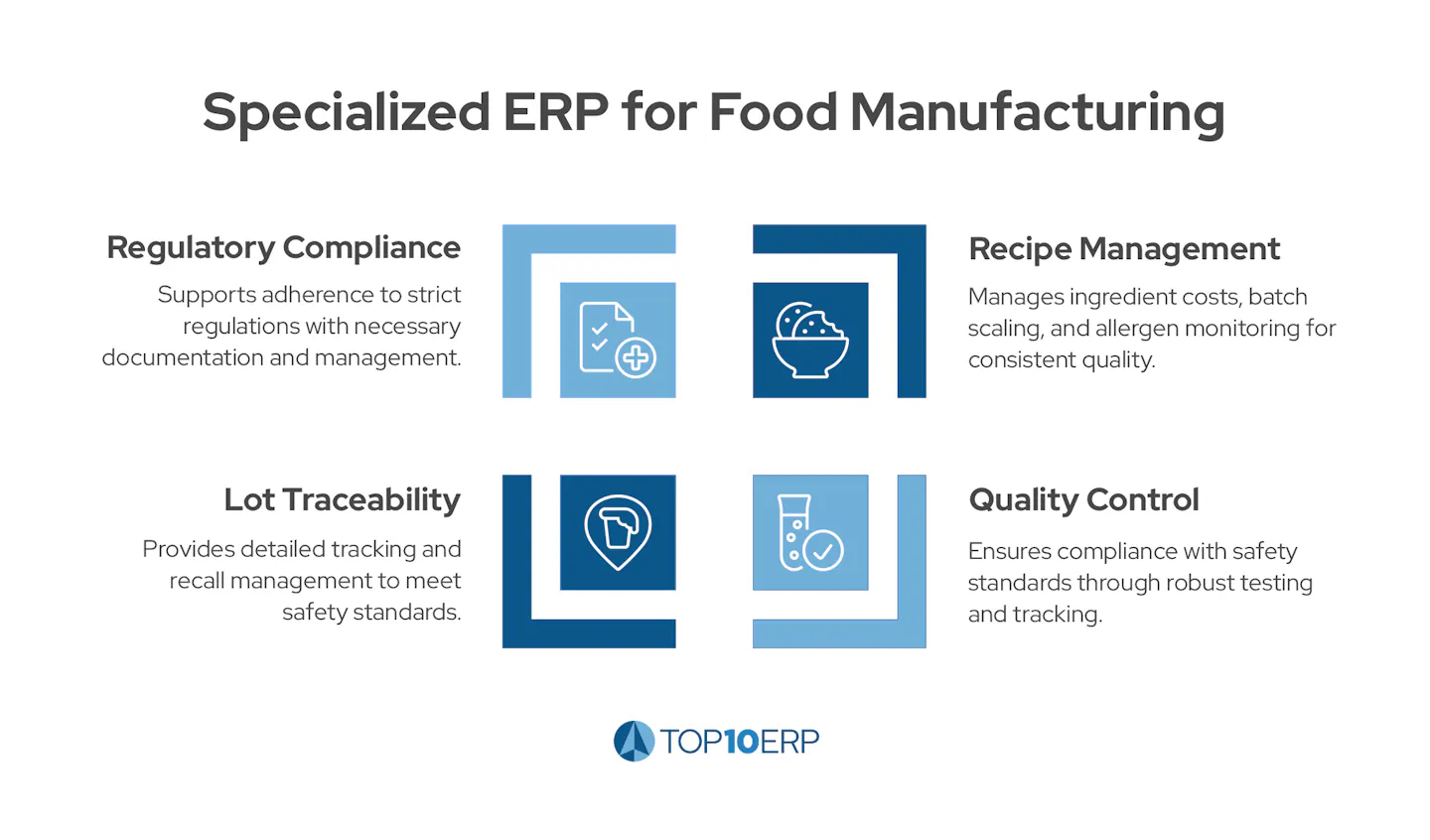
Standard ERP systems can create operational challenges for food manufacturers. Our analysis reveals four critical gaps that impact production efficiency and compliance:
Recipe Management
Many food ERP software systems can’t handle recipe complexity. They lack tools for ingredient cost tracking, batch scaling, and allergen monitoring. Without these features, manufacturers struggle to maintain consistent product quality and manage production costs effectively.
Quality Control
Food safety demands robust quality management. Standard ERPs miss critical features like Certificate of Analysis tracking, automated testing workflows, and hold status management. These gaps create compliance risks and slow down quality verification processes.
Sustainability and ESG Compliance
Food manufacturers are facing growing pressure to track and report their environmental impact. Standard ERPs lack carbon footprint monitoring, waste reduction metrics, supply chain sustainability tracking, and comprehensive ESG reporting tools. As of 2026, leading food ERP systems now embed these features directly into procurement, production, and reporting workflows rather than requiring separate sustainability platforms.
Lot Traceability
Basic tracking systems don’t meet food industry standards. Many ERPs lack the detailed lot tracking, supplier connections, and recall management tools needed for food safety. This makes recalls slower and more expensive to execute.
Regulatory Compliance
Food manufacturers must meet strict regulatory requirements. Standard ERPs don’t include FSMA documentation, HACCP management, or SQF certification support, forcing many food companies to maintain separate systems or manual processes to ensure compliance.
How We Evaluate Food Manufacturing ERP Systems
Our evaluation focuses on real-world performance in food manufacturing environments. We examine each system through four critical lenses:
Core Manufacturing Features: We evaluate essential food production capabilities, including recipe management, lot tracking, and quality control. Systems earn high marks for features like automated batch scaling, allergen tracking, and integrated quality testing.
Technical Architecture: The underlying system design impacts long-term success. We assess integration capabilities, AI-powered analytics for quality prediction and demand forecasting, customization tools, and deployment options. Cloud systems must demonstrate reliable performance and security, while on-premise solutions need efficient update processes and strong data management.
Implementation and Training: Even great software fails without proper implementation. We examine vendor implementation methods, training programs, and data migration tools. Top systems include industry-specific templates, food safety validation protocols, role-based training materials, and exceptional customer support.
Vendor Capability: We investigate each vendor’s food industry experience, support quality, and financial stability. This includes reviewing their development roadmap, checking customer satisfaction data, and assessing their industry partnerships.
Related Whitepaper: 7 Questions You Should Ask ERP Vendors
Top 10 Food Manufacturing ERP Systems Reviewed
The systems in our top 10 list below exceed food manufacturing necessities. Each demonstrates proven success with recipe management, quality control, compliance reporting, and traceability. We’ve verified their effectiveness through customer feedback and hands-on testing.
Click here to get free demos and price quotes for all 10 systems.
Now, let’s examine each system in detail.
1. BatchMaster Manufacturing ERP
BatchMaster specializes in formula-based manufacturing software designed specifically for food and beverage producers. The system integrates with leading financial platforms, including SAP Business One, Microsoft Dynamics GP, Sage 100⁄300 ERP, and QuickBooks. Whether on-premise or in the cloud, BatchMaster focuses exclusively on process manufacturing needs.

BatchMaster Manufacturing
BatchMaster ERP software is an excellent choice for food manufacturers who are working to expand and grow their operations. Through BatchMaster’s embedded functionality, a food manufacturer can easily add powerful functions such as batch production, costing and inventory management to the software they already use. Their process manufacturing solutions are built for smooth and simple integration with SAP Business One, QuickBooks and other popular enterprise software.

Key Strengths
- Comprehensive formula management with dynamic batch scaling and nutritional tracking
- Built-in quality control with integrated lab testing and compliance documentation
- Advanced lot traceability for ingredient and finished product tracking
- Direct integration with major financial software platforms
- Mobile warehouse management and production tracking
- Specialized features for allergen control and nutritional calculations
Best Fit For
BatchMaster serves small to mid-sized food manufacturers that need strong batch production controls and formula management. It’s particularly effective for companies that:
- Require detailed quality tracking and compliance documentation
- Want to keep their existing financial software
- Need specialized features for recipe management and scaling
- Have complex production scheduling requirements
2. Deacom ERP
Deacom, now part of ECI Software Solutions, provides a unified ERP platform explicitly built for batch and process manufacturers. Their “ONE” philosophy delivers all functionality in a single system without third-party add-ons. The platform offers two versions: Essentials for growing manufacturers and Enterprise for complex operations.

Deacom ERP
Deacom ERP is a unified ERP platform by ECI Software Solutions for manufacturers and distributors. It integrates features like inventory management, CRM, and eCommerce within one system. Designed for process manufacturers, it ensures regulatory compliance and adapts to changing market demands.

Key Strengths
- Complete in-house development with no third-party modules
- Native warehouse management, formulation, and quality control
- Real-time processing and reporting across all functions
- Built-in ecommerce and direct store delivery capabilities
- Transparent, predictable pricing structure
- 98% implementation success rate
- In-house support team with no outsourcing
Best Fit For
Deacom serves growing batch manufacturers who want a comprehensive, scalable solution. It’s particularly well-suited for companies that:
- Need all functionality in one integrated system
- Want to eliminate multiple software vendors
- Require FDA validation and regulatory compliance
- Plan significant business growth
- Operate multiple facilities or global operations
3. INFOR Cloudsuite Process (Infor M3)
Infor M3 is an enterprise-grade cloud ERP solution designed for process manufacturers, including food and beverage companies. Built on the Infor OS platform, it combines industry-specific functionality with advanced technologies like AI and machine learning to support complex food and beverage operations across multiple sites and countries.
INFOR Cloudsuite Process (Infor M3)
Infor M3 is a robust Cloud ERP tailored for industries such as chemicals and food. It provides enhanced security, reduces overall costs, and eliminates the need for major software upgrades. Built on the Infor OS platform, it extends capabilities with features like data management and AI.


Key Strengths
- Comprehensive manufacturing operations suite supporting discrete, process, and mixed-mode production
- Advanced supply chain planning with specialized workbenches for food & beverage
- Built-in laboratory and inspection control for quality management
- Fresh Food Planner and Yield Optimizer modules for food-specific optimization
- Robust lot and allocation control for traceability
- AI-powered analytics through Infor Coleman
- Continuous cloud updates without disruptive upgrades
- Extensive third-party integration capabilities through standard APIs
- Built-in compliance and regulatory controls
- Multi-site, multi-company architecture
Best Fit For
Infor M3 is ideal for mid to large-sized food manufacturers who need:
- Complex process manufacturing capabilities
- Advanced supply chain optimization
- Multi-site, global operations management
- Strong regulatory compliance tools
- Integration with existing systems
- Cloud-based scalability and flexibility
- Specialized food industry functionality without customization
4. inecta Food ERP
inecta Food ERP is a cloud-based solution built specifically for food and beverage manufacturers, offering comprehensive functionality from production through distribution. With 20 years of industry focus, the system provides specialized features for food safety, recipe management, and regulatory compliance across multiple countries.

inecta Food ERP
inecta Food ERP has served the food and beverage industry for 20 years, connecting multi-national and international brands globally. It features advanced materials management, sales processing, financial control, and production management capabilities with real-time insights and regulatory compliance tools.

Key Strengths
- ERP designed and build specifically for the Food Industry
- Comprehensive recipe management with R&D and chef’s view capabilities
- FSMA 204 compliant traceability with multi-level BOM lot tracking
- Flexible inventory control supporting FIFO/LIFO/FEFO and catch weight handling
- Mobile warehouse management with offline capabilities
- Advanced pricing system with bracket, zone, and delivery options
- Real-time MRP with time-bucket planning views
Best Fit For
inecta Food ERP serves small to mid-sized food manufacturers and distributors who:
- Need complete food safety and compliance tracking
- Require flexible pricing and commission structures
- Have complex recipe and formula requirements
- Operate multiple warehouse locations
- Value real-time production visibility
5. Sage X3 ERP
Sage X3, formerly Sage Business Cloud Enterprise Management, offers a flexible ERP solution that scales up to 1,500 users. The system provides deployment options including cloud (AWS), on-premise, or partner-hosted solutions. It’s built on Sage’s SAFE platform, offering both web and client/server access.

Sage X3 ERP
Sage X3 ERP is a flexible, web-based software suite for financial, sales, and operational management, suitable for global, multi-currency businesses. It provides customizable workflows, mobile responsiveness, and integration with third-party systems, focused on efficiency and scalability.

Key Strengths
- Comprehensive financial management with multi-currency support
- Real-time business intelligence without a separate data warehouse
- Integrated quality control and traceability
- Flexible deployment options (cloud, on-premise, hybrid)
- Built-in RF warehouse management
- Advanced purchasing and inventory control
- Mobile-responsive design across devices
Best Fit For
Sage X3 serves mid-sized to large manufacturers who need flexible deployment options. It’s particularly suited for companies that:
- Operate across multiple countries or currencies
- Need strong financial controls and reporting
- Want integrated warehouse management
- Require sophisticated purchase planning
- Value deployment flexibility
- Need to support remote users
6. QAD Adaptive
QAD Adaptive is a cloud-native ERP platform purpose-built for food and beverage manufacturers, powered by Champion AI to turn operations from passive systems of record into active systems of action. The platform supports process, discrete, and mixed-mode manufacturing with deep expertise across shelf-stable products, frozen foods, fresh produce, bakery, meat processing, spirits/wine/beer, and confectionery.

QAD Adaptive
QAD Adaptive is a cloud-based solution for global manufacturers, combining traditional ERP with a modern interface. It integrates features like Financial and Supply Chain Management, complemented by apps like QAD EQMS. Designed for adaptability and growth, it offers 24/7 support and rapid deployment.

Key Strengths
- Champion AI agentic platform that autonomously optimizes inventory, automates routine tasks, and drives real-time operational decisions
- Comprehensive lot and batch traceability with serialization, supporting field-to-fork visibility and rapid targeted recalls by ingredient, recipe, or batch
- Built-in catch weight capabilities for accurate billing and costing when products vary by weight
- Recipe and formula management with batch scaling and production execution controls
- Quality management integration (QAD EQMS) supporting FDA, HACCP, FSMA, BRCGS, SQF, and other global food safety standards
- Fully embedded Warehouse Management System with FIFO/FEFO picking logic and expiry date management
- Enhanced production scheduling with changeover optimization and resource allocation
- Champion Pace rapid implementation methodology delivering go-lives in as little as 90 days
Best Fit For
QAD Adaptive serves mid-to-large food and beverage manufacturers and is particularly suited for companies that
- Operate in regulated environments with stringent food safety and quality requirements
- Need end-to-end traceability from raw materials through customer delivery
- Require catch weight functionality for variable-weight products
- Manage complex formulations, allergen controls, and batch genealogy
- Operate across multiple manufacturing sites or countries
- Need AI-driven optimization for inventory management and production scheduling
- Want to accelerate ERP deployment and achieve rapid time-to-value
7. JustFood ERP
Aptean offers a Microsoft-based ERP solution specifically designed for food and beverage manufacturers. Built on Dynamics 365 for Finance and Supply Chain Management, it’s the largest Microsoft-certified food & beverage ERP in North America. The system follows Microsoft’s semi-annual release schedule, ensuring regular updates and seamless integration with Microsoft platforms.

JustFood ERP
JustFood ERP, now part of Aptean Food & Beverage, offers a cloud ERP solution for the food industry, integrating all business processes from production to delivery. It's designed specifically for food processors and distributors, ensuring quality control, safety, and compliance while providing anytime access to business data.

Key Strengths
- Purpose-built cloud system designed for food manufacturing and distribution specifically
- 15+ years of Food industry focus
- Bi-directional traceability
- Advanced recipe management and R&D tools with integrated formulation testing and batch processing
- Complete regulatory compliance support for SQF, BRC, FSMA, GFSI, and HACCP initiatives
- Integrated allergen management and QR code tracking for consumer transparency
- Modular architecture allows companies to add advanced features like EDI and mobile warehouse management as needed
Best Fit For
JustFood ERP best suits small to mid-sized food manufacturers and distributors. It’s particularly well-suited for companies that:
- Operate in chocolate, bakery, sauces, dressings, spices, seafood, meat, poultry, or frozen foods sectors
- Need comprehensive food safety and regulatory compliance tracking
- Require strong recipe development and formulation capabilities
- Want to avoid expensive customization with an industry-specific system
8. DELMIAWorks (IQMS)
DELMIAworks Manufacturing ERP System offers a unique single-vendor approach that combines ERP and Manufacturing Execution System (MES) in one platform. Built on Oracle database technology, it provides comprehensive food manufacturing functionality without needing third-party integrations.

DELMIAWorks
DELMIAWorks (Previously IQMS) Manufacturing ERP stands out as a holistic ERP and MES solution tailored specifically for the manufacturing industry, addressing the unique needs and challenges faced by manufacturers globally. Notably, its single-source development ensures that the system is less complex and more cost-effective than multi-solution alternatives.

Key Strengths
- Single-vendor ERP and MES solution on one Oracle-based platform without third-party integrations
- Real-time shop floor monitoring and data collection with “shop floor first” design
- Modular, scalable architecture allowing phased implementation
- Comprehensive recipe management and batch processing for food manufacturing
- Two-way lot and serial number traceability from raw materials through distribution
- Built-in quality management system (QMS) with audit support for FDA, FSMA, and GFSI compliance
- Integrated warehouse management, EDI, and maintenance (MRO) capabilities
Best Fit For
DELMIAWorks serves small to mid-market manufacturers who need comprehensive functionality without complexity. It’s particularly suited for companies that:
- Operate in food and beverage, automotive, aerospace, plastics, or packaging industries
- Need integrated ERP and MES without expensive third-party systems
- Require ingredient traceability, shelf-life tracking, and food safety compliance
- Want to start with core features and add modules over time
- Manage discrete, repetitive, or batch process manufacturing
- Are transitioning from QuickBooks or entry-level systems
- Need multi-plant seasonal demand forecasting and volume scheduling
9. Enterprise 21
Enterprise 21 offers a single-source ERP solution developed, implemented, and supported exclusively by TGI. The system provides comprehensive functionality without requiring additional modules or third-party add-ons, making it particularly suitable for small to mid-market manufacturers.

Enterprise 21 ERP
Enterprise 21 ERP, by TGI, serves small to mid-sized manufacturers and distributors with integrated business solutions. It offers unique customization, eliminating the need for external modules. For manufacturers, it provides robust tracking and compliance features; for distributors, it enhances warehouse management.

Key Strengths
- Complete forward and backward lot traceability
- Integrated formula and recipe management
- Scalable batch production controls
- Built-in quality control processing
- Multi-facility inventory management
- RF-enabled warehouse operations
- Direct vendor support and implementation
Best Fit For
Enterprise 21 serves organizations seeking a comprehensive, single-vendor solution. It’s ideal for companies that:
- Specialize in the Dairy industry
- Want a direct relationship with the software developer
- Need flexible deployment options
- Prefer avoiding third-party integrations
- Require centralized purchasing control
- Value simplified IT infrastructure
- Plan moderate growth without system changes
10. Wherefour ERP
Wherefour is a cloud-based ERP purpose-built for food and beverage manufacturers that take traceability and compliance seriously. The platform provides end-to-end ingredient tracking, production management, and audit-ready documentation for 21 CFR part 11, GMP, SQF, HACCP, and FSMA 204 standards, all within a single system that doesn’t require a large IT team to run. Wherefour pairs its software with personalized onboarding and ongoing support from real people, not a ticket queue, making it a standout for food and beverage producers who want a system that works from day one and stays that way.

Wherefour ERP
Wherefour ERP is a cloud-based ERP designed for food and beverage manufacturers that require deep traceability and regulatory compliance. The system has strong built-in support for GMP, SQF, HACCP, and FSMA 204 standards. Wherefour modules provide inventory management, procurement, production management, and order fulfillment capabilities in a user-friendly interface suited to small and mid-sized operations.

See a side-by-side comparison of these 10 systems or request free demos and price quotes.
Key Strengths
- End-to-end lot traceability from raw material receipt through finished goods
- Built for FSMA 204 compliance
- AI-assisted compliance setup
- Integrated quality control with configurable control points
- Automatic COA bundling with shipments
- Built-in compliance documentation
- Personalized implementation and support
Best Fit For
Wherefour serves small to mid-sized food and beverage manufacturers who need real traceability and compliance without the complexity of enterprise ERP. It’s particularly well-suited for companies that:
- Require FSMA 204-compliant lot traceability as a core business requirement — not an afterthought
- Need to pass 21 CFR part 11, SQF, HACCP, or GMP audits and want documentation built into daily operations
- Produce batch-based products with multi-level Bills of Materials and production records
- Are outgrowing spreadsheets or QuickBooks and want a system purpose-built for their industry
- Value direct, responsive support from people who understand food manufacturing, not a generic help desk
- Want a fast implementation with a clear path to go-live without a months-long consulting engagement
- Operate in food, beverage, nutraceuticals, confections, snack foods, or cannabis manufacturing
Click here to get free demos and price quotes for all 10 systems.
How to Choose the Right Food ERP Software
After reviewing our top 10 systems, the selection process comes down to matching your specific needs with each system’s strengths. Here’s how to evaluate your options:
Assess Your Manufacturing Model
Your production type largely determines which systems will work best:
- Batch production needs strong recipe management and scaling
- Continuous processing requires real-time monitoring
- Mixed-mode manufacturing demands flexible scheduling
- Make-to-order operations need strong configuration tools
Consider Implementation Resources
Different systems require varying levels of internal support:
- Cloud solutions like IFS minimize IT requirements
- On-premise systems like BatchMaster need stronger IT teams
- Single-vendor solutions like Enterprise 21 simplify support
- Integrated platforms like Deacom reduce technical complexity
Evaluate Growth Plans
Your future needs should guide system selection:
- Regional expansion requires multi-site capabilities
- International growth needs multi-currency support
- Product line expansion demands formula flexibility
- Acquisition plans require scalable architecture
Match Food and Beverage Industry Requirements
Food manufacturing brings specific demands:
- Quality control and testing protocols
- Regulatory compliance documentation
- Allergen management capabilities
- Recall tracking and execution tools
Compare Total Cost of Ownership
Look beyond initial pricing to understand:
- Implementation costs and timeframes
- Training requirements and resources
- Ongoing support and maintenance fees
- Hardware and infrastructure needs
- Study our ERP pricing guide for additional advice
Next Steps for Food and Beverage Manufacturers
Choosing the right ERP system for your food manufacturing business is a significant decision. At Top10ERP, we specialize in guiding manufacturers through the selection process to ensure you find the perfect fit for your operations.

Our comprehensive ERP Comparison Tool allows you to evaluate food industry-specific features side-by-side, helping you understand the key differences between leading systems. Compare everything from recipe management capabilities to compliance features and implementation requirements.
Schedule a call with one of our experienced advisors for personalized guidance. We’ll learn about your specific needs and handpick the best solutions for your food business. Whether you’re focused on batch processing, quality control, or regulatory compliance, we’ll help you find ERP food and beverage software that matches your requirements and budget.
FAQs
What level of traceability do food manufacturers actually need in their ERP system?
Food manufacturers need complete forward and backward lot traceability. In other words, tracking any ingredient from supplier through production to customer delivery and back. This means knowing which specific ingredient lots went into which production batches, where those batches shipped, and having the ability to execute targeted recalls by ingredient, recipe, or batch. Basic tracking that can’t connect ingredient lots to finished goods creates significant risk during recalls.
How do food ERP systems handle FSMA and HACCP compliance requirements?
Food ERP systems include compliance tools directly in production workflows rather than requiring separate systems. This includes FSMA 204 traceability, HACCP control point monitoring, Certificate of Analysis tracking, and automated compliance reporting. The key difference is that compliance documentation happens automatically during normal operations with quality checkpoints and testing results built into the production process rather than handled separately.
What makes process manufacturing ERPs different from discrete manufacturing systems?
Process manufacturing ERPs handle recipes and formulas instead of bills of materials. They track ingredients by batch and lot, handle catch weight products that vary by weight, and scale recipes while maintaining ratios. Standard discrete ERPs struggle with formula scaling and catch weight functionality.
What’s the difference between shelf life tracking and expiration date management?
Shelf life tracking monitors how long products remain saleable from production date, while expiration date management enforces FEFO (first expired, first out) picking and prevents shipping expired inventory. Food ERP systems track both production dates and expiration dates, alert warehouse staff to approaching expirations, and block transactions for expired lots. They also manage different shelf life rules for raw materials versus finished goods.
Do food manufacturers need separate quality management systems or is ERP-integrated quality sufficient?
Integrated quality management within the ERP is generally more effective than separate QMS systems because it eliminates duplicate data entry and ensures quality data flows directly into production decisions. Systems like QAD and DELMIAWorks provide built-in quality management supporting FDA, HACCP, and FSMA requirements without third-party integration. Separate systems create data silos and slow down quality verification processes.